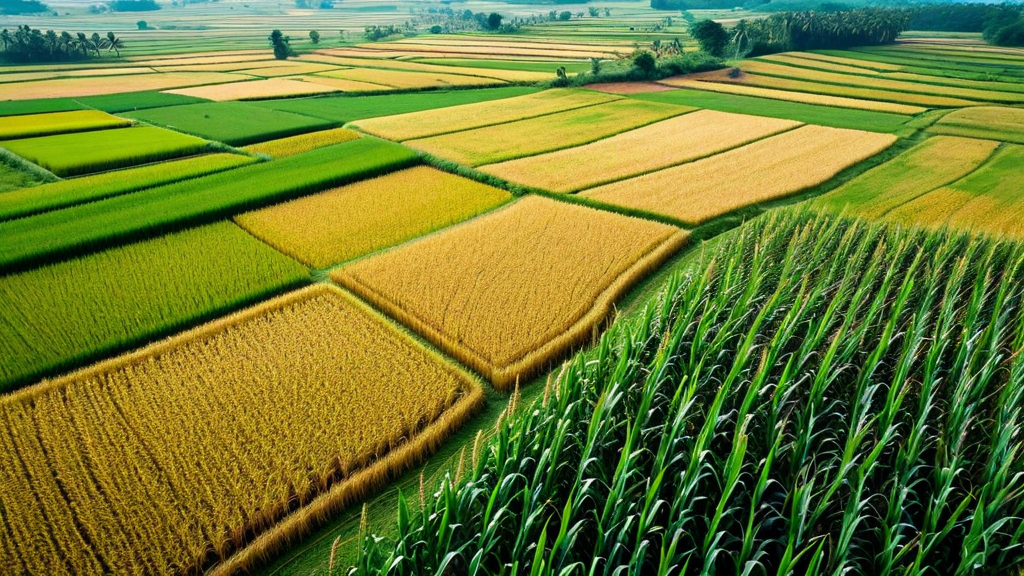
Global cereal yield growth rates have decelerated. Between 1965 and 1990, the Green Revolution and its aftermath delivered compound annual yield increases of roughly 2.5 percent for wheat and rice. Since 1990, that rate has dropped below 1 percent in both crops. In the years since 2010, several climate models have attributed a measurable fraction of this deceleration — estimated at 2.5 to 5 percent of total production in wheat and 3 to 4 percent in maize — directly to climate change. The stress that matters most is not a single catastrophic event but cumulative: more frequent periods of moderate heat and water deficit, arriving at more variable and less predictable crop growth stages.
The Production Geography Is Already Shifting
Published trend analyses of crop production data from the last three decades consistently show the same pattern: yield growth in historically reliable production zones is slowing, while production from higher-latitude regions — northern Canada, Siberia, northern Europe — is expanding into previously unsuitable areas. This poleward shift is often cited as a potential silver lining of warming, but it misrepresents the net balance. Temperate expansion does not compensate for tropical and subtropical decline. The regions losing agricultural viability — the Sahel, South Asia, Central America, parts of the Middle East — are also home to the largest concentrations of food-insecure populations. The people most exposed to agricultural climate risk are not the ones gaining from northern range expansion.
The South Asian wheat belt is one of the most closely studied cases. India and Pakistan together produce roughly 15 percent of global wheat. The Indo-Gangetic Plain, which spans much of northern India and Pakistan's Punjab province, has experienced a measurable increase in heat stress during wheat anthesis and grain filling since the early 2000s. A 2021 analysis published in Nature Food by Lobell et al. estimated that climate trends had reduced South Asian wheat yields by 5.2 percent between 1980 and 2010, and that this negative trend was accelerating. Under a 2°C warming scenario, South Asian wheat production faces declines of 16 to 18 percent without adaptation, based on current crop model projections.
Maize in the Tropics: A More Acute Problem
Maize is more heat-sensitive than wheat during pollination. The silk — the female reproductive structure — desiccates rapidly when air temperature exceeds 35°C during the two-week pollination window. Unlike wheat, where pollen production failure is the primary driver of heat-induced yield loss, maize can fail to pollinate successfully even when pollen is viable if the silk dries before fertilization occurs. This makes maize particularly vulnerable to heat events that coincide with pollination timing, which is both more likely and harder to predict as climate variability increases.
Sub-Saharan Africa produces most of its caloric staples from maize. The International Maize and Wheat Improvement Center (CIMMYT) estimates that, under business-as-usual climate trajectories, maize yields in sub-Saharan Africa could fall by 20 to 30 percent by 2050 relative to current yields without accelerated varietal improvement. This projection is not uniform: East African highland systems face different stress profiles than West African savanna environments, which differ again from Southern African dryland production. But the directional signal is consistent across all scenarios: existing varieties are not adequate for the production environments they will face within the working lifetime of current farmers.
Rice and the Compound Stress Problem
Lowland irrigated rice — which produces about 75 percent of global rice supply — is under pressure from multiple converging stresses simultaneously. Water scarcity is reducing available irrigation water in major Asian production regions: northern China, northwest India, and the Central Valley of California (a significant US rice producer) are all experiencing long-term groundwater depletion that is reducing irrigation capacity. At the same time, higher nighttime temperatures are increasing dark respiration in rice, where the plant burns carbohydrate reserves during the night, reducing net carbon accumulation and final grain yield. Each additional degree of mean nighttime temperature reduces rice yield by approximately 0.5 to 1.0 percent across production environments studied.
Higher CO2 concentrations — a consequence of the same emissions that are warming the planet — provide a partial offsetting benefit for C3 crops like rice and wheat through CO2 fertilization: higher atmospheric CO2 reduces photorespiratory losses and increases water use efficiency. But field-based FACE (Free Air CO2 Enrichment) experiments consistently show that the yield benefit of elevated CO2 is substantially smaller than climate model projections suggested, particularly under high temperature conditions where the CO2 benefit diminishes. The net balance of CO2 fertilization against heat and drought stress is negative in most tropical and subtropical production environments under 2°C and above warming scenarios.
What Genetic Approaches Can and Cannot Address
It is worth being precise about what plant genetics can contribute to this problem, because the temptation in crop biotechnology communications is to oversell the scope of the solution. Genetic improvement can do three things with proven effectiveness: reduce the rate of yield loss per unit of stress (stress tolerance), accelerate crop development to escape stress at critical growth stages (stress avoidance via early maturity), and maintain yield stability across variable environments (broad adaptation). It cannot fully compensate for extreme stress events where temperatures or water deficit exceed fundamental biological thresholds. It cannot substitute for the agronomic inputs — water, soil fertility, pest management — that determine the ceiling within which genetics operates.
That said, the gap between what current genetics can deliver and what it will be able to deliver within ten years is real and significant. The CRISPR-based editing tools now available allow plant scientists to precisely modify stress response mechanisms that could not be effectively targeted by conventional breeding, either because the causal genes were not identified or because the allele combinations required could not be assembled by conventional crossing due to linkage drag and recombination constraints.
Specific Targets Where Gene Editing Offers Tractable Solutions
Improving Water Use Efficiency Without Yield Penalty
The fundamental trade-off in drought tolerance is between water conservation (stomatal closure, reduced leaf area) and photosynthesis (which requires CO2 uptake through open stomata). Breeding programs that select for reduced canopy water use often select inadvertently for reduced photosynthetic rates, producing varieties that use less water but also produce less grain. Gene editing enables more targeted interventions: modifying only the sensitivity of stomatal response to water deficit signals, rather than altering stomatal density or aperture size globally. Edited varieties with altered SLAC1 or ABA receptor sensitivity show water use reductions without proportional photosynthesis reduction — a trade-off profile that is very difficult to achieve through conventional selection.
Preserving Pollen Viability Under Heat
The reproductive sensitivity to heat is a target that conventional breeding has repeatedly tried and largely failed to address, because the relevant genetic variation in most commercial crop gene pools is limited. CRISPR provides access to allelic variation from wild relatives and distantly adapted landraces that cannot be easily introgressed into elite germplasm by crossing due to reproductive barriers or yield-dragging linkage. Precisely installing the specific functional variants identified in heat-tolerant germplasm into elite adapted backgrounds — without the yield penalty that comes from carrying a large genomic segment from a low-yielding wild relative — is a task that gene editing handles much more efficiently than conventional introgression.
Accelerating Crop Development to Avoid Stress Timing
Modifying flowering time genes — particularly the photoperiod sensitivity loci Ppd-1 and Eps (early per se) in wheat, and the maturity genes in soybean — allows breeders to shift crop phenology to avoid the most severe heat and drought stress windows. Gene editing of these loci can produce finer phenological adjustment than natural allele substitution, enabling varieties to be precisely adapted to specific target environments rather than requiring broad-adaptation compromises.
The Timeline Problem
The gap between the timeline of climate change and the timeline of crop variety development creates a coordination challenge that is not primarily a scientific problem but a systems problem. A gene-edited variety initiated in 2025 will complete its development and regulatory pathway by approximately 2030 under favorable assumptions. It will require two to five years for commercial seed multiplication to reach meaningful production area. The broad adoption curve for new varieties in subsistence farming systems typically spans a decade or more.
This means that solutions deployed now will reach meaningful scale in the 2035 to 2045 timeframe — exactly when the climate projections suggest the production stress from 1.5 to 2°C warming will be most acute. The urgency of the development timeline is not about the science moving too slowly. It is about the fact that the development and deployment pipeline is long enough that starting sooner meaningfully changes outcomes at the critical window.
ClimateCrop designs its development pipeline around this timeline reality: prioritizing traits and crop species where the regulatory pathway is fastest (US SECURE framework, Brazilian CTNBio), and maintaining active development programs in all major production crops simultaneously rather than sequencing them. The math of climate adaptation is unforgiving: years lost in early-stage research are years lost at the deployment end, when the crop stress is most severe.